Questions & Discussion:
1. If we don’t get our globalizing theories from the archives, where are we getting them from?
2. Are we reading this to get a sense of Farge? Or a background on Foucault?
- Perhaps more of the former, but Foucault’s knowledge presumes a lot of knowledge of
the history of France, which can be disorienting, so this might help flesh that out.
3. Can we pair the discussion of emotion with the discussion of order, etc. within the districts?
4. (p. 28) What are Farge’s theoretical commitments such that it wouldn’t matter to distinguish
between things as imagined versus things as they were?
5. is it possible to map her analytical categories? We’ve done this for Foucault, but might be
helpful for Farge.
-Categories are concepts that the inquirer brings to bear on their objects of inquiry.
Lenses through which the historians look at things. Emotion would be one example
-Is she reading through emotion to make a claim about the archive? Farge describes
emotion as something that brings you into a certain relation with the archives
-Maybe more like an analytical standpoint than a category?
-(p. 27)- “not our purpose here to sort out the true from the false” but about to think about
attitude, anticipation, hopes. In doing so, “the declaration [the woman] makes is a
testament to her social and emotional existence”
-Is she talking about emotion as a methodological connection or something else?
-Farge says there are limits if you try to be objective
She perceives her ability to see the emotion of others
-This is because of the kinds of documents she is looking at. It’s impossible (she says) to
interact with these kinds of documents without bringing emotion into it
-In the introduction, her own objection is that it’s perceived that emotion can lead to
personal projection. Unclear what the limits are of this emotional attitude
-Also draws on limits of aestheticizing the archive
-Impossible to avoid some kind of anachronism just because of the difference in eras
between written and when it’s read. So there’s a serious tension
-Is the “emotion that requires our acknowledgement” the historian’s emotion, the emotion
in the archives, or both? It’s not obvious that you need to be in touch with certain
faculties in order to engage with documents using those faculties. Not getting the
register on which emotion is primarily operating for her.
-She says that it’s both. It’s not a fusion between historian and archives— it’s the
creation of a reciprocity.
-You can have an emotional relationship with something that itself bears no emotional
content.
-In the discipline of history, you're usually not even focusing on affect. So she’s saying
that in order to engage with certain things, the historian has to be able to attend to affect.
-How does this map on to foucault’s claims that certain kinds of power creates certain
kinds of subjectivity? She’s saying that affect gives you certain access to something, but
that shared emotion might diminish the subjectivity of people in the past.
-We need to draw a distinction between identifying with the contents of the emotions of
the ppl in the archives, she’s bringing emotion to mind in order to access. But they don’t
have to be feeling the same thing.
-So why call it emotion? Because of how she distinguishes between the archives and the
objects? She goes through the categories through the fragments
-might be interesting to reframe the question as “what do you get out of this?” Her
advisor invented history of mentalities. These histories still reached back for the
formalism and structuralism that they were intending to break from. The reaction was a
micro-history approach that overly dramatized or to veer back (now) toward structuralist
history. Emotion might help us maintain the ability to reach farther while still keeping a
structure. It has to be a balance between poor people and Louis XIV.
-You’re adjusting constantly to the text, constantly in reciprocity with it
-So the capacity of the historian for emotion allows them to place certain weight on
emotions in history
-Allows you to start generalizing emotions in text. Often think of foucault as doing “mid-
range theory”— reaching just enough past what is found to give you something, but not
reaching too far
-Can’t ignore anachronisms
-Category of adjustment:
-Is this providing for a certain need for public order?
-Adjustment between institutions? Modes of power?
-Adjustment between personal and collective behavior and the authorities
-When we talk about adjustment to norms, are we talking about a category of power? Is
this coming into a certain subjectivity?
-(p. 36) how does that category enable her to describe events as she is here describing
them? If she weren’t using that category [adjustment], so what kinds of descriptions
would she be limited?
-Convincing because she’s clearly reading between the lines, reading something in
between the testimonies.
-Different stories of the woman who slept with the guy right before marriage, and we
don’t get a master narrative, but we get some kind of relation that allows us to sit on
them without a master narrative
-Are we seeing adjustment between the men and women within the narrative or
adjustment between the stories (leading to the disjointed nature of the chapter itself?)
-(p 28) encounters as they actually happened vs encounters as they are dreamt to be
-It doesn’t matter if it’s true or false; it matters if it’s a candidate for possible truth. -
reading through foucault, if it’s a part of a discursive formation.
-It isn’t an exact science, but she’s hinting that you can add things up and get to an
outline of something. Through an aggregation, you can get a hint of something
-It’s also interesting that there’s this movement (also in Disorderly Families) that this
seemingly-difficult to know chaotic space is made known both to representatives of the
space (enough that authorities can try to formalize and control) and to the historian.
-We’re always looking at things obliquely, especially when it comes to private life
-that makes sense for private lives, but for disorderly families it seems like the opposite
because it’s about the lives of families coming into contact with the state apparatus
-At the beginning of chapter 3, she draws a different conclusion about the place of the
judicial system than she does in Disorderly Families. She says through the courts,
people’s honor could be preserved. In Disorderly Families, it seems that shame would
be brought through the judicial system, so try to subvert with lettres
- In this chapter, honor can be preserved judicially, etc. because women can adjust their
testimony. But the sleeping beauty example, that adjustment would not preserve honor.
Her honor isn’t tied up with his, whereas if she accused her husband of something, then
it would be.
6. would love to get clearer on concept of emotion, especially the subject that’s presupposed. -
What kinds of subjectivity are being assumed?
7. not clear how chapters are formed. How would we describe her writing style? What are the
advantages of how she’s written these archives up?
-This is not “mid-range theory,” perhaps. It felt like a series of episodes. This was mostly
details and not many generalizations.
-“honor” could be a mid-range concept that’s tying things like speech and the district
together
-So then the question is, “does the category of emotion play a role in that mid-ranging, or
that generalization?
Thursday, February 8, 2018

Thursday, February 1, 2018
Foucault & Farge, Disorderly Families, III. When Addressing the King
We began with questions
1. p. 254 - social history disrupts the linearity of history. What is the temporality of the history of social practices? How does it differ from the temporality of discourses? What are the implications of these temporalities for periodization?
2. What is at stake in these different metaphors? How do they produce different readings?
- testify (p. 252) -- the letters test
- illustrate (p. 253)
- living site / space (p. 259)
3. p. 255 - the randomization of police procedures is brought into view; but what is evidence for this randomness.
4. Why don't they attend to the formatting of the letters?
5. Why do they see the letters, and their writers, as "insignificant" (p. 257)? Or as "trivial" (p. 256)? Or as small? Why focus on what is scaled-down?
6. Why did they print the letters themselves? Why print them alongside the analysis and the aggregation and sorting? Why do we need the letters for the argument to work?
-- What do they give us that we wouldn't otherwise have?
7. They claim the documents are not "raw" utterances (p. 256).
8. The question of the secret (p. 257).
---
The history of social practices never as linear as the documents would have us believe (p. 254) - the documents seem to belie a linearity - but how? - by way of the contents of the documents themselves, or by way of a quantitative count?
Practices v. discourses (p. 254)
- Distinguishing:
- Practices as producing texts, lettres, discourses
- Practices
Formats - what the format of the letters can't speak to, e.g. popular criticism of the king.
Question of the relationship between the letters and the introductory material. How would we reread this book as itself an archival document, a record of Foucault's-Farge's historiographical procedure? How would one reread these original archival documents as a record of how Foucault & Farge worked and wrote?
The letters as excessive to their use value. The aesthetic-experimental dimension of the book.
Why the focus on the insignificant and the trivial? The history of what seems trivial.
1. p. 254 - social history disrupts the linearity of history. What is the temporality of the history of social practices? How does it differ from the temporality of discourses? What are the implications of these temporalities for periodization?
2. What is at stake in these different metaphors? How do they produce different readings?
- testify (p. 252) -- the letters test
- illustrate (p. 253)
- living site / space (p. 259)
3. p. 255 - the randomization of police procedures is brought into view; but what is evidence for this randomness.
4. Why don't they attend to the formatting of the letters?
5. Why do they see the letters, and their writers, as "insignificant" (p. 257)? Or as "trivial" (p. 256)? Or as small? Why focus on what is scaled-down?
6. Why did they print the letters themselves? Why print them alongside the analysis and the aggregation and sorting? Why do we need the letters for the argument to work?
-- What do they give us that we wouldn't otherwise have?
7. They claim the documents are not "raw" utterances (p. 256).
8. The question of the secret (p. 257).
---
The history of social practices never as linear as the documents would have us believe (p. 254) - the documents seem to belie a linearity - but how? - by way of the contents of the documents themselves, or by way of a quantitative count?
Practices v. discourses (p. 254)
- Distinguishing:
- Practices as producing texts, lettres, discourses
- Practices
Formats - what the format of the letters can't speak to, e.g. popular criticism of the king.
Question of the relationship between the letters and the introductory material. How would we reread this book as itself an archival document, a record of Foucault's-Farge's historiographical procedure? How would one reread these original archival documents as a record of how Foucault & Farge worked and wrote?
The letters as excessive to their use value. The aesthetic-experimental dimension of the book.
Why the focus on the insignificant and the trivial? The history of what seems trivial.
Thursday, January 25, 2018
Farge and Foucault, Disorderly Families, II. Parents and Children
Overview of the letters in Section 2 (each of us volunteered to summarize one subsection):
Disruption of Affairs - questions of chronology arose in this section because some letters were not dated
Shameful Concubinage - focus on daughters in this section; interesting references to conception of children as significant; often those making the petition were fathers
Dishonor of Waywardness - tbd
Domestic Violence section - focused on theft; few cases of parents complaining against daughter (so case on p. 205 of suicidal daughter stands out)
Bad Apprentices - similar theme of sons being sent to apprenticeships and becoming drunks and libertines
Exiles - the punishment does not seem proportional to the behavior
Fam Honor - this section is mostly women; direct appeals to honor
Parental Ethos I - all arrestees in this section were male; the direction of the appeals is not always clear.
Parental Ethos II - tbd
Throughout sections, the theme presented in the section headings didn't seem to differentiate these letters from those in other sections. Also striking was the ages of the children (early to late 20s), which raises questions of dividing line between adulthood and childhood.
Discussion of Letters and Foucault's Introductory Texts:
Questions:
Why do they organize the archival material into subsections?
How does one tease out the prevalence of a certain style of justification in these letters, given that others exist? Why do some of these become organizing principles for compiling and organizing the letters?
Discussion:
Foucault's discussion of the shift from 1728 to 1758 (135ff.) is interesting (from affection to education); very Foucauldian attention to shifts (did not appear in previous section).
The two introductions are clearly written by two different people. Are the two introductions reflective of two different historiographical approaches? "Tableaus of conjugal life" (29) v. "existence of a model, a framework" (135) in a process of "evolution". Social groups v. historical differentiation (135).
What is at stake in organizing concepts like "threshold"? How does one locate a distinction in an archive? Why not theorize those "thresholds" as proper places in their own right?
How is Fouc's introduction functioning?
Disruption of Affairs - questions of chronology arose in this section because some letters were not dated
Shameful Concubinage - focus on daughters in this section; interesting references to conception of children as significant; often those making the petition were fathers
Dishonor of Waywardness - tbd
Domestic Violence section - focused on theft; few cases of parents complaining against daughter (so case on p. 205 of suicidal daughter stands out)
Bad Apprentices - similar theme of sons being sent to apprenticeships and becoming drunks and libertines
Exiles - the punishment does not seem proportional to the behavior
Fam Honor - this section is mostly women; direct appeals to honor
Parental Ethos I - all arrestees in this section were male; the direction of the appeals is not always clear.
Parental Ethos II - tbd
Throughout sections, the theme presented in the section headings didn't seem to differentiate these letters from those in other sections. Also striking was the ages of the children (early to late 20s), which raises questions of dividing line between adulthood and childhood.
Discussion of Letters and Foucault's Introductory Texts:
Questions:
Why do they organize the archival material into subsections?
How does one tease out the prevalence of a certain style of justification in these letters, given that others exist? Why do some of these become organizing principles for compiling and organizing the letters?
Discussion:
Foucault's discussion of the shift from 1728 to 1758 (135ff.) is interesting (from affection to education); very Foucauldian attention to shifts (did not appear in previous section).
The two introductions are clearly written by two different people. Are the two introductions reflective of two different historiographical approaches? "Tableaus of conjugal life" (29) v. "existence of a model, a framework" (135) in a process of "evolution". Social groups v. historical differentiation (135).
What is at stake in organizing concepts like "threshold"? How does one locate a distinction in an archive? Why not theorize those "thresholds" as proper places in their own right?
How is Fouc's introduction functioning?
Thursday, January 18, 2018
Foucault & Farge, Disorderly Families, I. Marital Discord
Thursday Jan.18, 2018
Questions
· * Emergence of terms (e.g. ‘madness,’ ‘debauchery,’
etc.) – relation between scribes & formalities of language of the lettres de cachet – who is determining
the language used in letters?
· * Do scribes literally transcribe what the
subjects are saying, or are they just compiled from notes?
· * How might we categorize medium in a Foucauldian
vocabulary? Is strategizing coupled with classification in a Foucauldian vocab?
(p.43)
· * Unpack the method of reading deployed here (e.g.
“surface of the couple” p.32-3)
· * Theme of repentance and relation of theme
through history of punitive practice (p.47) How clearly do these claims connect
to MF’s narrative histories of punishment? Emergence of the social attitude of
repentance – as cause for disciplinary punishment? (p.48)
· * How does gender map onto the organization of the
letters?
Responses
Method of reading
– how are they describing the reading on p.32? – What emerges from the reading
of these petitions? – interlaced systems of values? Surface – why use this
language? Is there a depth? Does the order of importance come from untangling
this system of values? Is it found within the genre of the writing?
What is the difference between the visible & the surface
that comes into view from the gaze of the others? (see also p.42) – Surfaces &
visibilities à
bringing a positivity into view
Reading method à collecting letters;
historiographical question of how one assembles the visbilities/positivities –
what is the empirical status of MF’s work? Positivities as facts. MF’s positivism
Positivities taking on different significance than those in D&P, where they have an added layer
of interpretation/analysis?
Reading for themes? Are they reading for the themes?
Reading as a question of seeing/visibility*
Documents that make visibilities sayable
Is this function of archival material or function of
private/public distinction or function of both?
Private life enigmatic to neighbors/to public.
Letters – mechanism by which their private life gets made
public – obscure lives make public this otherwise private concern
What is meant by public & private here? Public – known by
authorities (police)? Because they were known by others?
Public/Private – public determined by the limits of the
sovereign – private, what is lost
Private – what gets lost, what is obscure? Public – what becomes
visible? What is visible?
Politics of the family – gendering of public/private (p.48-9)
letters prior to reified gendering of the split between the private/public * (Both
husband/wife make these petitions)
What belongs to genre of letter-writing – where the
discourse comes from that is used in the letters? Categories belonging to the
genre? Do they correspond with categories used by different genres (e.g. court
proceedings, letters written by neighbors)
Imprecision as the medium through which the 18th
century police worked (p.43) – Why is imprecision a medium rather than a
strategy or a technique? Notion of the imprecise police à imprecision = substance
in which the police works because sovereign power is also imprecise
Police not generating the stakes (or the categories) of the
practice, but are reactive.
Thursday, January 11, 2018
Farge & Foucault, Disorderly Families, Introduction and Afterword
Introduction and Afterword:
Disorderly Families
1. Can we discuss the representativeness of the
sample? (pg. 27). Found it surprising that they picked two years. Interesting
archival choice. Why did they pick the two years?
2. What do we make of the
attention to affect in the afterword - specifically, how is affect influencing
how they read the archive and how they interpret it (especially the technique
of copying as creating a kind of intimacy between Farge, Foucault, and the
lives they are reading about) (pg. 269-270)?
3. Why did they write a book
that is largely just the reproduction of archival material?
4. Can we discuss these
sense of construction implied in the "greats" constructing systems designed
to dismiss common people? (pg. 268)
5. Is the function of the
text as a presentation of archives different from the function of a text like Discipline and Punish?
"This is where this
register's paradox lies: it freezes the lives of people quite suddenly, yet at
the same time a feeling of incessant movement, of constant circulation, escapes
from it" (pg. 22).
There is a freezing of the
fugitive world - one of incessant movement. The archive doubles this freezing/movement.
What is modest means? What
does it mean that families were paying to have family members imprisoned? What
are these letters really for? What function do they serve? The aristocracy did
not write these kinds of letters. These letters fly in the face of common
interpretations of French history in terms of the relation between the
sovereign and the people.
These letters reveal
previously unknown lives — rendering singular lives part of history. But how do
we connect this with Foucault's other projects? An ethical gesture - a way of presenting the
archives in a way that leaves the archives open. This might be why the
periodization matters - a way of tending to the shift from sovereign to
disciplinary power without specifically referencing it (he does end up making
it explicit in some other passages - 130 and 260). Repentance emerges as a
theme that marks the shift from sovereignty to discipline (technique of
correction). On 24, the family ends up reflecting the relationships of
sovereign power while being embedded in a host of other relationships.
Is there a lack of
periodization in the piece overall? What would a history have looked like? Why
didn't they pick middle dates? Why not 1743? Self-evident affect positioned
against quantitative representativeness - how is the archivist implicated in
such a project? How is the archivist implicated in the reproduction of archival
material? The practice of writing history seems like an important theme of the
text - experiment with different ways of writing history. These different
practices of writing performs different kind work. There is a spirit of experimentation
at work. If we think of the archives as the writing of history and the
uncovered lives coming into contact with power as the writing of history, this
another way of performing that very writing (in the style of the original). D&P does not perform the writing of
the panopticon, but this piece does perform the writing of the dossiers - an
artistic style. Is it artistic or is it an aesthetic positivity? What does the
experiment consist of? It is an interesting experiment to just reproduce it. "Drawing
an intricate portrait" (268) as an aesthetic that differs from a more theoretical-historical
account - (271) "Foucault saw a tableau where misery would challenge
glory."
Some of the archival
documents where difficult to read and there is an interpretative element
involved in puzzling them together. Does the archive speak for itself? Can we
make a distinction between the archive speaking for itself and it doing something
on its own? For Foucault, the archive doesn't speak for itself in the sense
that it tells us how it should be read. But there are facts that do things for
themselves within the world of the archive (there is a positivity to them).
There is an interesting tension between the sublime nature of the lives (a
politics from below) and the positivity of documenting a form of power. There
is affective tension in the text that has an impact on how they present the
material (suffering-tragedy-intimacy).
Is the practice of reading,
assembling, writing the archive here the same as that in D&P - He seems to reverse engineer the practice of reading in
the Lives of Dangerous Men. The texts
make an ethical claim on him that he doesn't talk about in terms of his earlier
texts based on archives - from the same archive, he is excavating different
projects and the writing is very different. How do we treat these letters
differently from how they were treated when they were written? Emotion informs
from the practice reading the archives for Farge.
Wednesday, January 10, 2018
A List of Foucault's Collaborations
Stuart Elden (one of the most diligent and insightful Foucault scholars working today) has a useful overview of some of Foucault's collaborative projects that may be of use to us this term and next. (Thanks to Nicolae for the link.)
https://progressivegeographies.com/resources/foucault-resources/foucaults-collaborative-projects/
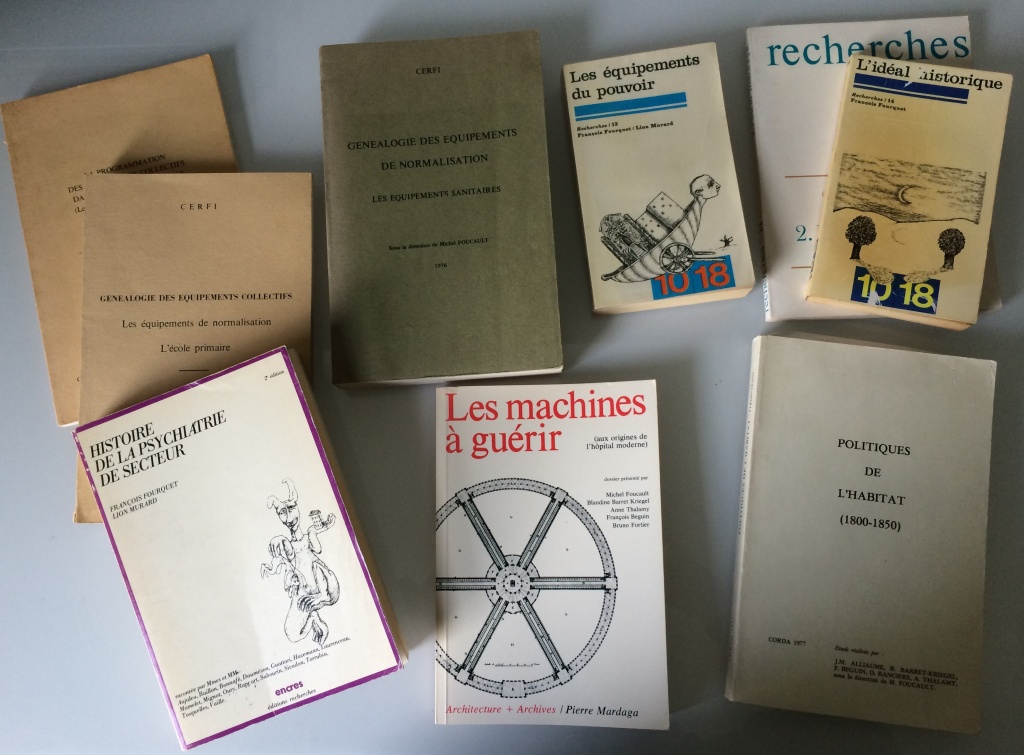
https://progressivegeographies.com/resources/foucault-resources/foucaults-collaborative-projects/
Monday, January 8, 2018
Winter Term 2018 Schedule
Continuing our theme for the year, on collaboration, we'll be reading the Disorderly Families project produced together by Arlette Farge and Michel Foucault. All meetings in Leona Tyler Conference Room off of the Graduate Student Lounge unless otherwise marked.
Thur 1/11 - Introduction (AF/MF), and Afterword (AF)
Thur 1/18 - Introduction to "Husbands and Wives" (AF), plus everyone read one section of letters
Thur 1/25 - Introduction to "Parents and Childrens" (MF), plus everyone read one section of letters
Thur 2/1 (location: Allen 332) - "When Adressing the King" (AF/MF)
Thur 2/8 (location: Allen 332)- Farge, Fragile Lives, pp 1-42
Thur 2/15 - Farge, Fragile Lives, pp 42-72
Thur 2/22 - Farge, Fragile Lives, pp. 169-204
Thur 3/1 (location tbd) - Farge, Fragile Lives, pp. 204-256
Thur 3/9 - Farge, Fragile Lives, pp. 256-287 (Ch. 10 and Conclusion)
Thur 3/15 - TBD, perhaps Foucault's "Lives of Infamous Men"?
Thur 1/11 - Introduction (AF/MF), and Afterword (AF)
Thur 1/18 - Introduction to "Husbands and Wives" (AF), plus everyone read one section of letters
Thur 1/25 - Introduction to "Parents and Childrens" (MF), plus everyone read one section of letters
Thur 2/1 (location: Allen 332) - "When Adressing the King" (AF/MF)
Thur 2/8 (location: Allen 332)- Farge, Fragile Lives, pp 1-42
Thur 2/15 - Farge, Fragile Lives, pp 42-72
Thur 2/22 - Farge, Fragile Lives, pp. 169-204
Thur 3/1 (location tbd) - Farge, Fragile Lives, pp. 204-256
Thur 3/9 - Farge, Fragile Lives, pp. 256-287 (Ch. 10 and Conclusion)
Thur 3/15 - TBD, perhaps Foucault's "Lives of Infamous Men"?
Subscribe to:
Posts (Atom)