Wednesday, March 9, 2016

Spr 2016 Reading Schedule

In the Spring quarter CGC will continue this year's inquiries into genealogical methods by way of surveying some adjacent methodological terrain charted by some of Foucault's interlocutors, contemporaries, and near-contemporaries.  We will read Gilles Deleuze, Bruno Latour, and Paul Veyne -- beginning in each instance with one of their essays on Foucault and then turning to some of their own contributions to historiography, methodology, and critical inquiry.

A draft schedule is below.  Meetings will be Fridays at 4:00.  During week 1 we will assign responsibilities for collecting, scanning, and distributing each week's readings.

G. Deleuze
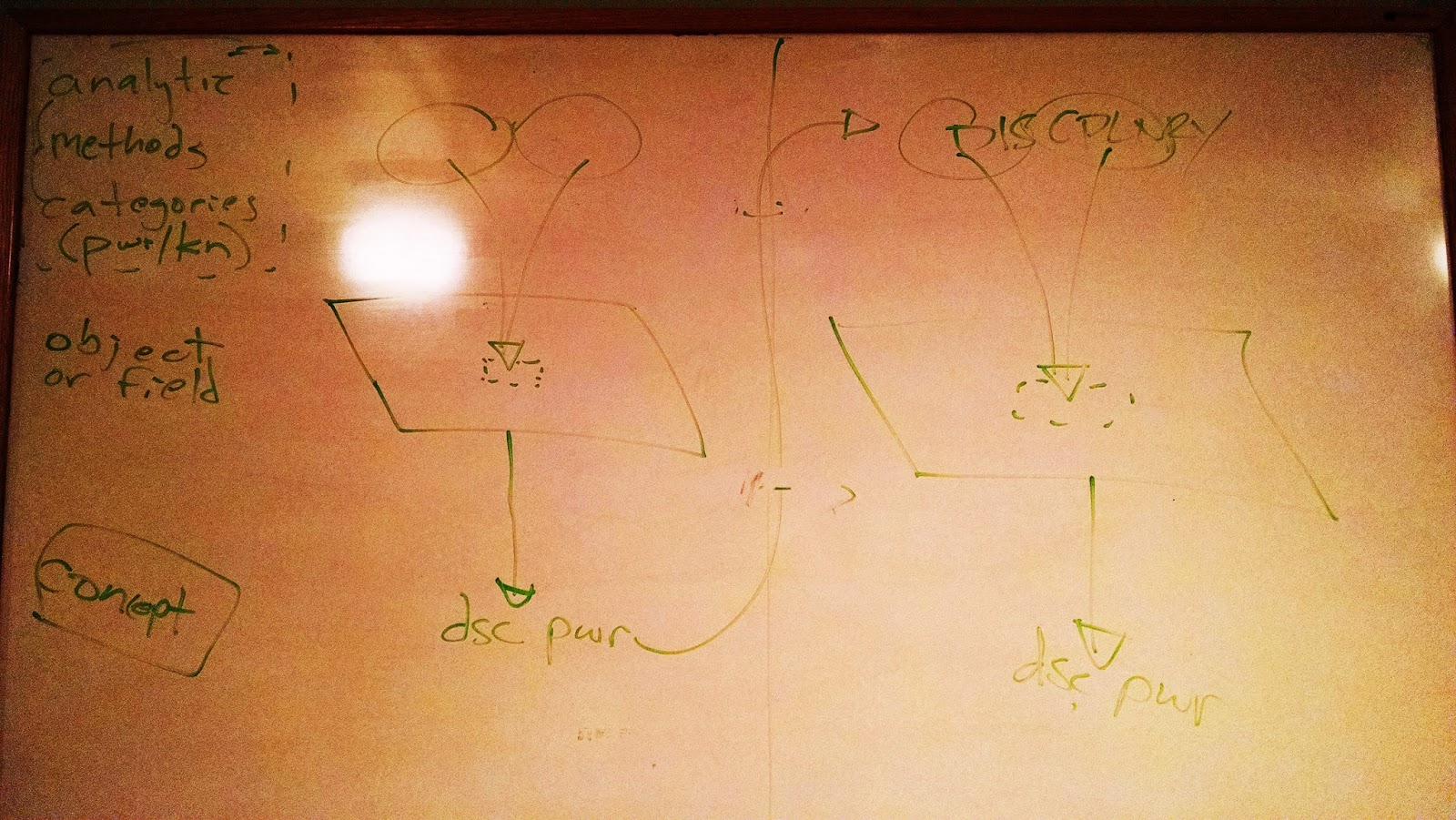
Wk 1) "What is a Dispositif?" (1989) and "Michel Foucault's Main Concepts" (1984), both from the collection of Deleuze essays Two Regimes of Madness
 
Wk 2) Selections from A Thousand Plateaus - Introduction “Rhizome;” Ch.3 “10,000 BC: The Geology of Morals” (1980)
 

Wk 3) Selections from Anti-Oedipus - Homo historia, Universal History, History of Contingencies (1971)
 

Wk 4) Selections from Logic of Sense - "First Series of Paradoxes of Pure Becoming;" "Second Series of Paradoxes of Surface Effects;" "Ninth Series of the Problematic;" "Fourteenth Series of Double Causality" (1968)

B. Latour
Wk 5) "The Powers of Association" (1986?) 


Wk 6)  “On Technical Mediation – Philosophy, Sociology, Genealogy” in Common Knowledge 3, no.2 (1994): 29-64.

Wk 7 - Fri May 13)  no meeting -- attend Foucault session at Trans conference

Wk 8) “The Historicity of Things: Where Were Microbes before Pasteur?” – from Pandora’s Hope (1999)


Wk 9) “Irreductions” from The Pasteurization of France (1984; 1988); (also recommended only: selections from Reassembling the Social (2005) – “Introduction to Part 1;” “First Source of Uncertainty;” “Second Source of Uncertainty;” “Third Source of Uncertainty;” “Introduction to Part 2” [refs to Foucault on 'society'])

P. Veyne
Wk 10 9) "Foucault Revolutionizes History"; (also recommended by Veyne from Writing History are the following: "History Does not Exist", "Pure Curiosity about the Specific", or "History, Sociology, and Complete History")

Thursday, February 18, 2016

Wtr 2016: Foucault's Transforming Analytics of Power

CGC this term collaborated on table that schematically tracks Foucault's transforming analytics of power from approx. 1973 (in the CdF lectures that year) to 1976 (as culminating in HSv1).


Tracking Foucault's Transforming Analytics of Power, 1973-76


[CK’s version per the work of the CGC in PHIL 607, Wtr 2016, ‘Genealogy Workshop’]

[The table below tracks changing configurations of Foucault's discussions of how to study power from approx. Mar '73 to Aug '76.  An attempt has been made to line up the various different statements with one another in rows that show approximations, but also alterations, in vocabulary.  Each column focuses on Foucault's explicit discussions of methodological points in the texts referenced; these are represented as the enumerated items in each column whilst additional items culled from other moments of the text are listed in italics and without enumeration.  Note finally that the terminology used in each cell contains no quotation marks b/c an attempt has been made to draw all technical terms used in each cell directly from the texts cited.]

Mar ‘73
(Pun. Soc.)
[4 ‘theoretical schemas’, 227-247)]
  
Dec '73
(Psych. Pwr.)
[3 analytic shifts from Hist.Mad. (12-16)]
  
Aug ‘74
(D&P, pub'd Feb '75)
[4 'rules' (23ff)]
  
Jan '75
(Abn.)
['a few [3] methodological reflections, 42-52]
  
Jan '76
(SMBD)
[5 ‘methodological precautions’ or ‘imperative commands’, 27-34]
Aug '76
(HSv1, pub'd Dec '76)
[ch. on 'Method': ‘a certain number [5] of propositions' (94-96)]
1) Exercised and not possessed or appropriated (228)


In dispersion relays, networks, reciprocal supports, differences of potential, discrepancies (rather than possessed) (4)
Exercised as strategy not possessed as property (26)

Power is exercised through the disqualification of the expert (35-36). Exercised over criminals, as mechanism (44).
3) Exercised through networks, never appropriated or a divided possession; circulatory, not applied (29)

Exercised and exists only in action (14), not possessed, transferred, or alienated (13)
1) Exercised from innumerable points in mobile relations, not acquired, seized, or shared (94)
2) Extensive, running through whole of social, absorptive; not localized, not concentrated (229) [cf. 2 below]
Focus on strategy rather than the family (15) or state (16)
[not sure if this one lines up in this row?]
Techniques covering entire social body (138)
Penetrating whole social body (87)
4) Ascending analysis of techniques and tactics; not deducing power from the center (30)

1) Capillary, at the extremeties, embodied in techniques, not at a single center (27)
3) Comes from below, not from the top down (94)
3) Constitutive of production, at the heart of production and labor, not merely reproducing production (231)
Disciplinary apparatuses are productive of the accumulation of men and distribution of labor forces (71-72)
Composition of forces (162-9)
2) Integrated w/ force (52), not superstructural to basal force (50)
Primarily a relationship of force, not the perpetuation and renewal of economic relations (15)
[As a more general form of preceding statements concerning force:] 2) Immanent in other types of relationships (incl. economic), not superstructural (94; cf. 98)
4) bound up with knowledge, not violence or ideology (234)


2a) power a game, not violence (14); in need of microphysics (16)
1) shift from analytics of representation to one of formation of discursive practices through apparatuses of power
3) Epistemological- juridical (23)
power produces knowledge (27)
abandon the violence-ideology opposition (28)


3) Functions with formation of a knowledge that is both its effect and condition (52), not linked to effects of ignorance (50)


5) "The delicate mechanisms of power cannot function unless knowledge, or rather knowledge apparatuses, are formed, organized, and put into circulation, and those apparatuses are not ideological trimmings or edifices" (34)
It is in discourse that power and knowledge are joined together (100)
Exclusion is not sufficient; exclusion happens on the basis of representations that are tactics of power; speaking just of exclusion obscures the tactics of power which generated representations (3)
Power is a productive instance of discursive practice; power produces discursive practices (13)
1) possible positive effects, not repressive effects alone (23)


1) A fundamentally positive power (48; cf. plague, 47ff.), not the notion of repression (43; cf. leprosy, 44ff.)
A struggle and continuation of war (Nietzsche), not essentially repressive (Hegel, Freud, Reich) (15ff.); critical use of ‘repression’ is spoiled (40)
Against the repressive hypothesis (throughout) and power as negative (83ff.); power as self-affirmation not enslavement (122ff.); Reich as central target of MF’s critique (131)
2) Distinguish power from political structures; focus on micro-instances of power (230) [cf. 2 above]
2b) Focus on the practical dispositions of power, before tackling institutions (15); see tactics (summary on 16)
2) Techniques and tactics, not necessarily from legislation or indicative of social structure (23)
The invention of general techniques (government, sexuality, &c.) that comprise a typical apparatus (48-49), invention of positive technologies of power.
5) Actual instruments, observational methods, recording techniques, &c. (33)

Techniques & tactics (34)
Not focused on, or developed through, institutions, but rather crated by techniques of power present at every level of the social body (141)
Evolution of morality is a history of bodies; penality in terms of the history of relations between political power and bodies (261; course summary)
Power's point of application is always the body; all power is physical (14)


4) Soul is effect of transformation of body (24)
The soul is the prison of the body (30)

Power invested in body (193)
In the 17th and 18th c. the emergence of techniques of disciplinary power centered on the body; contrast to biopower of man-as-species (242)
A type of power brought to bear on the body and on sex (47); and also, resistance through bodies and pleasures (157)
?
?
?
?
2) Where power relates directly and is invested in real and effective practices, not where power is intentional; grasp the material agency of subjugation (28)

4) Intentional and nonsubjective because tactical rather than result of choice or decision (94-5)

“Civil war is the permanent state on the basis of which a number of these tactics of struggle… should be understood” (13); cf. also 70-71 CdF ‘LWTK’
?
?
?
"Binary schema of war and struggle" as basis for civil society, esp. "race struggle" and "class struggle" as "the two great schemata used to identify the phenomenon of war” (18-19)
5) Always paired with resistance, a mobile and plural and transitory resistance; and no single locus of great refusal (95-6)
END (for now)


Tuesday, January 12, 2016

Wtr 2016 Diagrams (from Genealogy Workshop)


'Hourglass of Threads' (on archaeology and genealogy relation): 


'Foucault's Iceberg' (diagram based on Paul Veyne's "Foucault Revolutionizes History"):


The Error of the 'Categorization' (or 'Daguerreotypification') of Concepts (i.e., 'Biopower-Hunting'):


Styles of Reasoning and Concepts (and their relation), via the work of Arnold Davidson, with speculative comparison to Foucault, Deleuze, Latour, & Wittgenstein


Figures and Practices, via Dilts


xxx

Monday, January 4, 2016

Wtr 2016 Reading Schedule

CGC this term will function as a 'Genealogy Workshop' in conjunction with Colin Koopman's PHIL 607 graduate seminar.  Our reading schedule is below.  We will post diagrams from the readings as we go, and hopefully also a methodological compendium drawn from these readings.  Ongoing transcriptions of the classes are also being kept (and a decision as to whether to post them or not will be made later).


Part I
Reading for Genealogy as Methodology
T 1/5
Foucault, Discipline and Punish (1975); (re)read in full before start of term


R 1/7
Foucault, The Punitive Society (72-73 CdF), pages 1-42, 65-84 (~60 pages)

T 1/12
Foucault, The Punitive Society (72-73 CdF), pages 89-135, 160-166 (~50 pages)

R 1/14
Foucault, The Punitive Society (72-73 CdF), pages 175-241 (~65 pages)

T 1/19
Foucault, Psychiatric Power (73-74 CdF), lectures 1, 3, and 12 (~75 pages)

R 1/21
Foucault, Abnormal (74-75 CdF), lectures 1, 2, and 11 (~75 pages)

Pt IIa
How to Do Inquiry: Researching and Composing Our Genealogies
                                & some more Genealogy in Foucault
T 1/26

-          First portion of class: project brainstorming discussion & exercises

-          Second portion of class: how to delimit a field of investigation, where to do inquiry, how to go into the field, how to cormorant a library, &c., &c.

R 1/28
Foucault, History of Sexuality, Vol. 1: The Will to Know (1976), I-IV.2 (~100 pgs)

-          Second portion of class: project discussion and further conceptualization

T 2/2   
Foucault, History of Sexuality, Vol. 1: The Will to Know, IV.3-V (~60 pages)
Foucault, “Society Must be Defended” (75-76 CdF), lecture 11 (~25 pages)

-          Second portion of class: framing projects and conceptualizing research plans

R 2/4

-          Project Presentations: initial research plans (problem, research site, timeline)
Pt IIa/b
The Work of Genealogical Inquiry: Our Genealogies
                                                         & Other Genealogies after Foucault
T 2/9
Arnold Davidson, The Emergence of Sexuality, chs. 1 & 2 (~65 pages)

R 2/11
Arnold Davidson, The Emergence of Sexuality, chs. 4, 7, & 8 (~60 pages)

-          Second portion of class: project sharing, collaboration, and updating

T 2/16
Ladelle McWhorter, Racism & Sexual Oppression, intro, ch. 1, ch. 3 (~110 pages)

R 2/18
Ladelle McWhorter, Racism & Sexual Oppression, chs. 4 & 5 (~100 pages)

-          Second portion of class: project sharing, collaboration, and updating

T 2/23
Andrew Dilts, Punishment and Inclusion, chs. 1-3 (~85 pages)

R 2/25
Andrew Dilts, Punishment and Inclusion, chs. 6-8 (~85 pages)

-          Second portion of class: project sharing, collaboration, and updating

T 3/1
Verena Erlenbusch, Terrorism: A Genealogy, draft ms., selected ch. (~50 pages)

R 3/4
NOTE: WE WILL NEED TO RESCHEDULE THIS SESSION
 
T 3/8
-          Project Presentations, First Session: finalized research presentations

R 3/10
-          Project Presentations, Second Session: finalized research presentations

Exam
-          Group Genealogy Papers: due by email at noon on Thur 3/17